- Friday, August 7, 2026
- Home
- Geo-politics
- 10 Geopolitical Concepts Everyone Should Know to Understand Global Politics
10 Geopolitical Concepts Everyone Should Know to Understand Global Politics
Every day, headlines mention terms like balance of power, deterrence, sphere of influence, and rules-based order. These phrases may sound technical, but they shape almost every international conflict, alliance, and diplomatic decision.
Understanding these concepts helps us move beyond simply reading the news—it helps us understand why countries act the way they do.
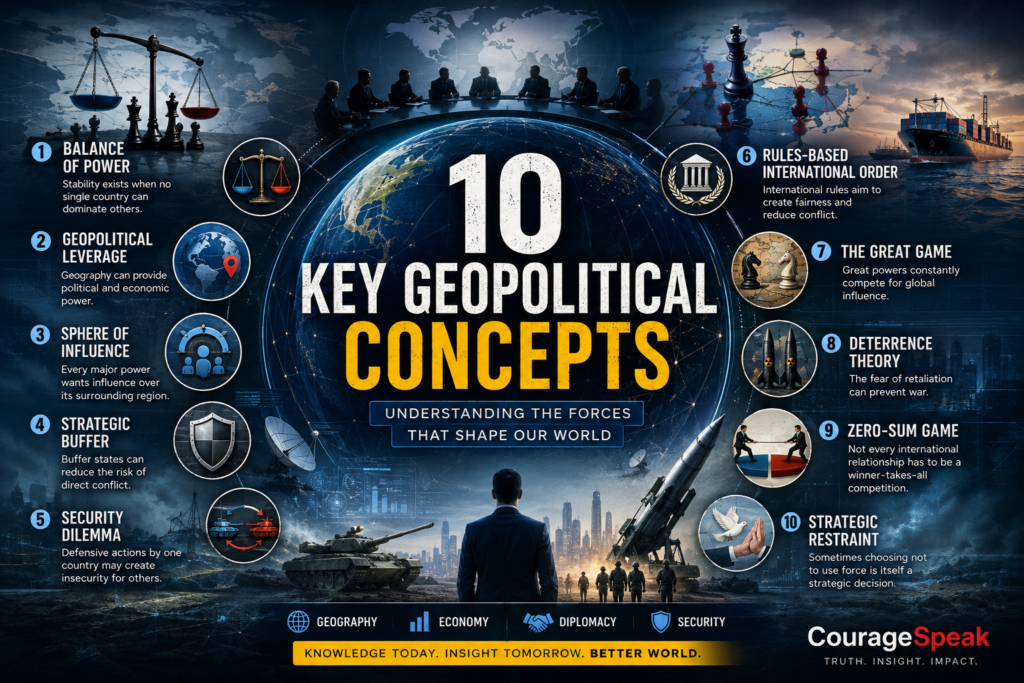
1. Balance of Power
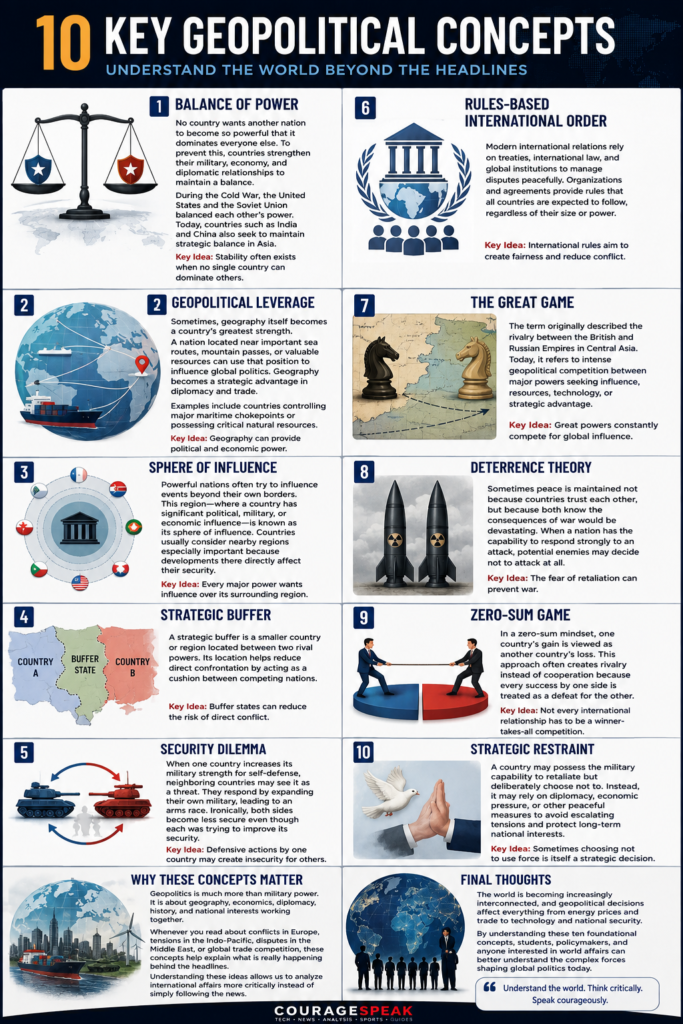
No country wants another nation to become so powerful that it dominates everyone else. To prevent this, countries strengthen their military, economy, and diplomatic relationships to maintain a balance.
During the Cold War, the United States and the Soviet Union balanced each other’s power. Today, countries such as India and China also seek to maintain strategic balance in Asia.
Key Idea: Stability often exists when no single country can dominate others.
2. Geopolitical Leverage
Sometimes, geography itself becomes a country’s greatest strength.
A nation located near important sea routes, mountain passes, or valuable resources can use that position to influence global politics. Geography becomes a strategic advantage in diplomacy and trade.
Examples include countries controlling major maritime chokepoints or possessing critical natural resources.
Key Idea: Geography can provide political and economic power.
3. Sphere of Influence
Powerful nations often try to influence events beyond their own borders.
This region—where a country has significant political, military, or economic influence—is known as its sphere of influence. Countries usually consider nearby regions especially important because developments there directly affect their security.
Key Idea: Every major power wants influence over its surrounding region.
4. Strategic Buffer
A strategic buffer is a smaller country or region located between two rival powers.
Its location helps reduce direct confrontation by acting as a cushion between competing nations.
Key Idea: Buffer states can reduce the risk of direct conflict.
5. Security Dilemma
When one country increases its military strength for self-defense, neighboring countries may see it as a threat.
They respond by expanding their own military, leading to an arms race. Ironically, both sides become less secure even though each was trying to improve its security.
Key Idea: Defensive actions by one country may create insecurity for others.
6. Rules-Based International Order
Modern international relations rely on treaties, international law, and global institutions to manage disputes peacefully.
Organizations and agreements provide rules that all countries are expected to follow, regardless of their size or power.
Key Idea: International rules aim to create fairness and reduce conflict.
7. The Great Game
The term originally described the rivalry between the British and Russian Empires in Central Asia.
Today, it refers to intense geopolitical competition between major powers seeking influence, resources, technology, or strategic advantage.
Key Idea: Great powers constantly compete for global influence.
8. Deterrence Theory
Sometimes peace is maintained not because countries trust each other, but because both know the consequences of war would be devastating.
When a nation has the capability to respond strongly to an attack, potential enemies may decide not to attack at all.
Key Idea: The fear of retaliation can prevent war.
9. Zero-Sum Game
In a zero-sum mindset, one country’s gain is viewed as another country’s loss.
This approach often creates rivalry instead of cooperation because every success by one side is treated as a defeat for the other.
Key Idea: Not every international relationship has to be a winner-takes-all competition.
10. Strategic Restraint
A country may possess the military capability to retaliate but deliberately choose not to.
Instead, it may rely on diplomacy, economic pressure, or other peaceful measures to avoid escalating tensions and protect long-term national interests.
Key Idea: Sometimes choosing not to use force is itself a strategic decision.
Why These Concepts Matter
Geopolitics is much more than military power. It is about geography, economics, diplomacy, history, and national interests working together.
Whenever you read about conflicts in Europe, tensions in the Indo-Pacific, disputes in the Middle East, or global trade competition, these concepts help explain what is really happening behind the headlines.
Understanding these ideas allows us to analyze international affairs more critically instead of simply following the news.
Final Thoughts
The world is becoming increasingly interconnected, and geopolitical decisions affect everything from energy prices and trade to technology and national security. By understanding these ten foundational concepts, students, policymakers, and anyone interested in world affairs can better understand the complex forces shaping global politics today.